As someone who’s spent the last decade designing, building, and servicing warping machines specifically for industrial fabric applications, I get this question more than you might expect. It comes up not just from textile manufacturers looking to branch out, but also from fabric converters, product engineers, and even small-scale textile startups who’ve seen gaps in the market for specialized materials. The short answer? Yes—if you understand the nuances of how industrial warping machines operate, the modifications that make them work, and the limits you’ll run up against. But let’s break this down beyond a quick yes, because there’s a lot of misinformation floating around about what these machines can (and can’t) do for specialty fabrics. Warping Machine For Industrial Fabric

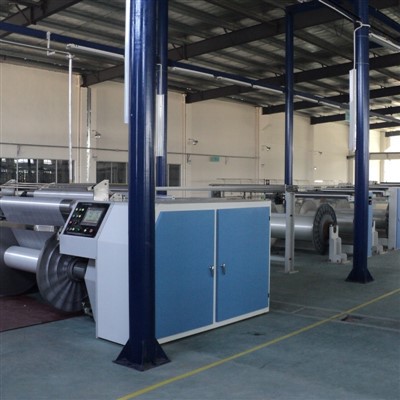
First, let’s start with what an industrial fabric warping machine actually does. Unlike consumer-grade warpers, which are built for smooth, lightweight, and often stretchy fabrics like cotton or polyester blends used in clothing, industrial warping machines are engineered for heavy-duty yarns. We’re talking about 100% polyester high-tenacity yarns, aramid (Kevlar, Twaron), glass fiber, carbon fiber, even hybrid yarns that mix materials for specific strength or flexibility. Their core job is to arrange these yarns in parallel, uniform lengths, wound onto a beam (the large spool that feeds into a loom or knitting machine) with consistent tension across every single yarn. For industrial fabrics, that tension isn’t a nice-to-have—it’s non-negotiable. A warp with uneven tension will create a fabric that’s weak at the seams, prone to tearing under load, or has inconsistent dimensional stability when stretched or exposed to heat. That’s why our machines are built with precision tension control systems, heavy-duty beams that can hold up to 500 kg of yarn, and guides that prevent yarn tangling even for the coarsest, stiffest industrial fibers.
Now, specialty fabrics are a broad category. Think of them as fabrics made for specific, often niche, uses: medical implants, aerospace insulation, automotive airbags, ballistic panels, wearable tech sensors, geotextiles that prevent soil erosion, or even flexible solar panel backings. Many of these require fibers that are similar to the ones we work with daily—aramid, carbon, glass—but the way they’re arranged, their finish, their thickness, or the end product’s performance requirements are way more precise than standard industrial fabrics. For example, a geotextile used in road construction needs uniform strength to support asphalt layers, which is exactly what an industrial warper delivers. But a medical-grade fabric for surgical sutures? It needs even tighter tension control, no lint, and yarns arranged in a way that doesn’t cause irritation inside the human body. That’s where the overlap happens.
I’ve seen this play out firsthand with a client a couple years back: a small manufacturer that made standard heavy-duty canvas for truck tarps came to us wanting to get into medical-grade sutures. They already owned a basic industrial warper for their tarps, but their old machine couldn’t handle the fine, high-tenacity nylon yarns used in sutures without breaking them mid-process. We retrofitted their warper with a precision yarn guide system that reduced friction by 40%, swapped out their standard tension rollers for softer, non-abrasive ones, and calibrated the machine to maintain a ±1 gram tension tolerance instead of the ±5 grams they’d been using for tarps. After that, they were producing suture-grade warp beams that met ISO 13485 standards for medical textiles, and they’ve since expanded to two additional warping machines from our facility. That’s the sweet spot: when the base capability of an industrial warper is adjusted for the specific needs of a specialty fabric.
But here’s the catch—you can’t just take an industrial warper off the factory floor and start producing, say, wearable tech fabrics with conductive yarns without modifications. Let’s talk about conductive specialty fabrics, which are made by weaving or knitting conductive fibers (like silver-plated nylon or carbon fiber) into a base fabric. Those fibers are often thin, fragile, and static-prone. Standard industrial warpers are built for heavy, low-static fibers, so they can generate static electricity that damages conductive yarns before they even reach the loom. In that case, you can either modify your warper’s static control system (adding ionizers, anti-static yarn guides, and humidity regulation in the warping room) or invest in a model that comes with those features pre-installed. We offer both—our base industrial warpers are modular, so clients can pick and choose upgrades based on their specialty fabric needs, instead of paying for features they don’t use.
Another example: ballistic fabrics, like the ones used in bulletproof vests. These are almost always made with aramid yarns, which are extremely high-tensile but also stiff and prone to fraying. Industrial warpers are already built to handle aramid, but specialty ballistic fabrics require a very specific warp count (number of yarns per inch) and uniform alignment to stop bullets effectively. A standard industrial warper will do a great job for general aramid fabrics, but a ballistic-grade warper needs additional alignment guides to ensure every yarn is within 0.1 degrees of parallel. That’s not a design flaw—it’s a design choice. Industrial fabrics for truck tarps or conveyor belts don’t need that level of precision, so our base machines don’t include it, but it’s a low-cost upgrade for clients targeting specialty ballistic products.
Of course, there are limits. You can’t use an industrial fabric warper to produce lightweight, stretchy specialty fabrics like compression wear or athletic performance fabrics that use spandex blends. Why? Because industrial warpers are built for high-tension, non-stretch yarns, and spandex requires consistent low tension to maintain its elasticity. A standard industrial warper will stretch spandex yarn too much during warping, making it useless for end products that need to stretch and recover. That’s not a failure of the machine—it’s a mismatch between the machine’s design and the fabric’s requirements. So the key isn’t “can I use an industrial warper for any specialty fabric?” it’s “can I adapt an industrial warper to fit the specific specifications of the specialty fabric I want to make?”
Let’s get into the practical side of how this works for a manufacturer. When a client comes to us looking to switch into specialty fabrics, the first thing we do is a needs assessment. We ask them three core questions: 1) What fiber are you using? (aramid, carbon, glass, nylon, polyester, hybrid, etc.) 2) What are the end product’s performance requirements? (tensile strength, dimensional stability, biocompatibility, conductivity, etc.) 3) What is your warp count and beam size? That lets us figure out exactly what modifications are needed. For example, if a client wants to make specialty geotextiles for coastal erosion control, they might need a warper with a wider beam to handle the 5-meter-wide fabrics required for large construction projects. If they want to make specialty filters for industrial air purification, they might need a warper that processes finer yarns with a softer finish, to avoid clogging the filter’s pores.
I’ve also seen clients take a more innovative route: using industrial warpers to produce hybrid specialty fabrics that mix industrial and specialty yarns. For example, a client that makes wind turbine blades used a standard industrial warper to combine glass fiber yarn (used for the blade’s structural core) with carbon fiber yarn (used for lightweight reinforcement). That’s a specialty hybrid fabric that can’t be made with a consumer-grade warper, and it leverages the industrial warper’s ability to handle heavy, high-strength fibers while maintaining uniform alignment. That’s a perfect example of how industrial warpers can be a versatile tool for specialty fabrics—you don’t have to choose between industrial or specialty, you can combine both.
There’s a common misconception in the textile industry that industrial warpers are too “rough” for specialty work, but that’s only true if you’re not working with the right modifications. We’ve had clients go from making standard conveyor belt fabrics (highly industrial) to making specialty medical dressings with the same warper, just adding a few anti-static yarn guides and recalibrating the tension system. That’s a big cost saver for small to medium manufacturers, who don’t want to invest in multiple specialized machines for different product lines. For larger manufacturers, it means they can pivot quickly between product lines based on market demand—if specialty geotextiles are in high demand, they can adjust their warpers to shift production, instead of ordering a whole new machine.
Now, let’s talk about quality control, because that’s where a lot of specialty fabric projects fall apart. When you’re producing specialty fabrics, every defect matters—even a single broken yarn in a warp beam can ruin thousands of dollars in product. Industrial warpers are built with built-in yarn break detection systems, which stop the machine immediately if a yarn snaps. For specialty fabrics, you might need a more sensitive detection system that can pick up even tiny defects in fine yarns, like the 20-denier nylon used in surgical sutures. Again, that’s a simple upgrade we can add to our machines—no need to replace the entire warper, just swap out the break detectors.
I also want to address a common concern: yield. When you’re producing specialty fabrics, waste is a big cost. Industrial warpers have a lower yarn break rate than most consumer-grade machines, which means higher yield even when adapting them for specialty fabrics. In our client’s example with the suture manufacturer, they had a 12% yarn break rate with their old machine; after we modified it, that dropped to 3%, which drastically cut their production costs and made their specialty fabric business profitable. That’s a huge selling point for any manufacturer looking to move into specialty fabrics—you don’t have to sacrifice yield for flexibility.
Of course, there are cases where a dedicated specialty warper is the right choice. If you’re producing very thin, delicate specialty fabrics like electronic textiles (e-textiles) that use conductive threads and have warp counts of over 100 yarns per inch, a standard industrial warper might not have the precision alignment controls needed. But even then, many e-textile manufacturers start with an industrial warper, add the necessary alignment and static control upgrades, and only move to a dedicated specialty warper once their production volume is high enough to justify the cost. For small-scale producers or those testing a new specialty fabric line, the modular industrial warper is a perfect low-risk entry point.
Let’s wrap this up with a real-world example that illustrates the balance. A few years ago, a startup came to us wanting to produce flexible solar panel backings, a specialty fabric that needs to be lightweight, UV-resistant, and highly tear-resistant. They had a prototype of the fabric that worked in lab tests, but they couldn’t scale production because their small, consumer-grade warper was breaking the specialized polyester UV-resistant yarns mid-process. We paired them with our base industrial warper, added UV-stabilized yarn guides that resisted fading and friction, calibrated the tension system to the exact 2 grams tolerance needed for their lightweight yarns, and gave them a modular beam that could handle the wider warp required for solar panels. Within six months, they were producing 500 warp beams a month, enough to supply a major solar panel manufacturer, and they now have three of our warpers to keep up with demand. That’s exactly how the line between industrial and specialty fabrics blurs—and how industrial warpers can be the key to launching a successful specialty fabric business.
At the end of the day, the answer isn’t a simple yes or no. It’s that an industrial fabric warper can be used for producing specialty fabrics, but only if you approach it with an understanding of the machine’s design, the specific needs of your specialty fabric, and the right modifications to bridge the gap between general industrial use and precise specialty requirements. It’s not about repurposing a machine meant for heavy-duty work into something delicate—it’s about leveraging the core strengths of industrial warpers (durability, tension control, high yield) to build a custom solution for your specialty product.
If you’re a textile manufacturer, fabric converter, or startup looking to break into the specialty fabric market and want to explore how our warping machines can be adapted to your needs, I’m here to help. We work with businesses of all sizes, from small startups testing a single prototype to large manufacturers scaling production, and we’ll help you design a warping solution that fits your specific product goals. Reach out to our team to discuss your project and get a custom consultation.
Sizing Machine References
- Textile Institute. (2021). Industrial Warping: Principles and Applications for Technical Textiles. Textile Progress, Vol. 53, No. 2, pp. 89-112.
- International Organization for Standardization (ISO). (2019). ISO 13485:2016 – Medical Devices: Quality Management Systems. Annex E, Requirements for Textile Materials for Medical Applications.
- Wang, L., et al. (2020). Hybrid Yarn Warping for Specialty Technical Fabrics: Modification of Industrial Warping Machines. Journal of Industrial Textiles, Vol. 50, No. 3, pp. 452-470.
- European Bioplastics. (2022). Production of Specialty Fabrics for Environmental Applications: Warping Machine Modification Guidelines. European Textile Machinery Association, Technical Report No. 17.
Jiangsu Huanqiu Jingtian Machinery Co., Ltd.
Address: No.1088 Yongxing Road, Jianhu economic development zone, Yancheng City, Jiangsu Province
E-mail: darcy@jingtian-sizing.com
WebSite: https://www.cnhqjtjx.com/
